
PEPTIDES PARTNERS BLOG · November 11, 2026
Exploring 5-Amino-1MQ: The Science, Mechanism, and Research Applications of NNMT Inhibition
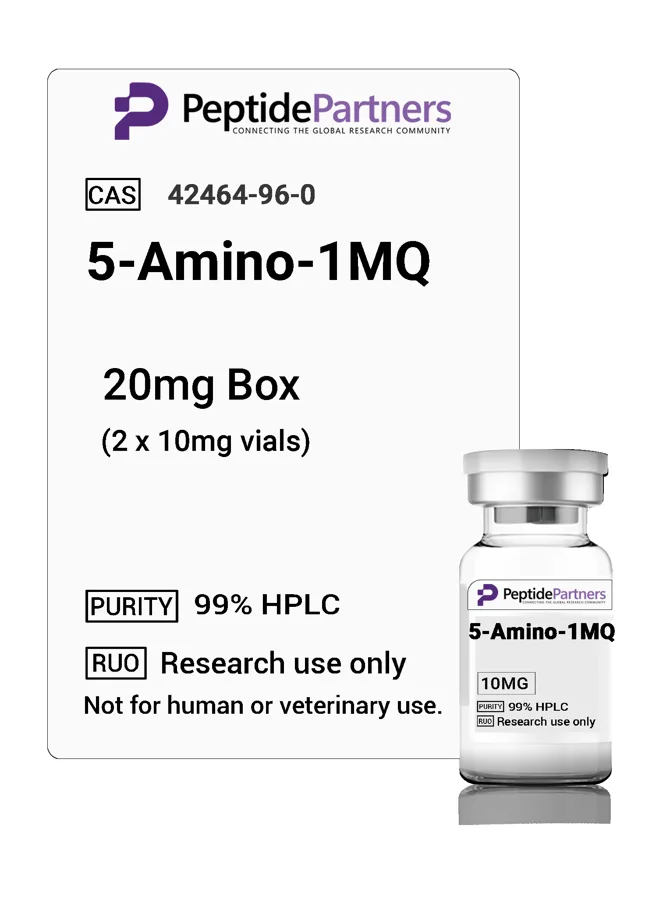
In the field of metabolic research, small molecules targeting epigenetic and energy-regulating enzymes have garnered significant scientific interest. Among these compounds, 5-Amino-1-methylquinolinium (commonly referred to in scientific literature as 5-Amino-1MQ) has emerged as a widely studied candidate. Positioned within the metabolic research category, 5-Amino-1MQ serves as a selective, membrane-permeable small molecule inhibitor targeting the enzyme nicotinamide N-methyltransferase (NNMT). Available exclusively for research and laboratory evaluation, this compound provides investigators with a specialized tool to probe cellular energy balance, NAD+ homeostasis, and downstream metabolic cascades without directly altering systemic hormonal axes.
The Discovery and Chemical Development of 5-Amino-1MQ
The development of 5-Amino-1MQ stems from targeted structural biology efforts aimed at identifying viable inhibitors of NNMT. The enzyme NNMT is primarily cytosolic and abundantly expressed in adipose tissue, the liver, and skeletal muscle. Historically, NNMT was viewed primarily as a phase II drug-metabolizing enzyme responsible for the methylation of pyridines and related structural analogs. However, research over the past decade shifted this paradigm, revealing that NNMT plays a regulatory role in cellular energy expenditure and nutrient flux.
High-throughput screening and structure-activity relationship (SAR) modeling conducted at academic institutions, notably research led by the University of Texas Medical Branch, identified the quinolinium scaffold as a potent framework for NNMT inhibition. Derivative profiling led to the synthesis of 5-Amino-1MQ, which demonstrated high selectivity for NNMT over related methyltransferases, such as nicotinamide phosphoribosyltransferase (NAMPT) and various histone methyltransferases. Its positive charge and structural characteristics allow cellular uptake, making it a critical tool for both in vitro cellular cultures and preclinical in vivo animal models.
Core Biological Mechanisms Investigated
To understand the utility of 5-Amino-1MQ in metabolic research, laboratory investigations focus primarily on two interconnected biochemical pathways: methyl donor availability and the nicotinamide adenine dinucleotide (NAD+) salvage pathway.
NNMT Inhibition and Substrate Preservation
NNMT catalyzes the transfer of a methyl group from S-adenosylmethionine (SAM) to nicotinamide (NAM), generating S-adenosylhomocysteine (SAH) and 1-methylnicotinamide (1-MNA). By selectively inhibiting this reaction, 5-Amino-1MQ influences two major intracellular balances:
- NAD+ Biosynthesis: Nicotinamide is a primary precursor for NAD+ generation via the salvage pathway mediated by NAMPT. When NNMT is overexpressed or hyperactive, it diverts NAM away from NAD+ synthesis toward excretion as 1-MNA. Inhibiting NNMT preserves the pool of available NAM, facilitating enhanced NAD+ replenishment in metabolically active cells.
- SAM/SAH Ratio Regulation: SAM serves as the primary methyl donor for DNA and histone methyltransferases. Excess consumption of SAM by elevated NNMT activity can alter the epigenetic landscape. Preclinical studies indicate that dampening NNMT activity with 5-Amino-1MQ preserves SAM levels, thereby stabilizing cellular methylation capacity.
Cellular Energetics and Mitochondrial Function
Because NAD+ acts as an essential cofactor for sirtuins (notably SIRT1 and SIRT3) and poly(ADP-ribose) polymerases (PARPs), modulation of NAD+ levels by 5-Amino-1MQ indirectly influences mitochondrial biogenesis and oxygen consumption rates. In experimental cell cultures, the administration of 5-Amino-1MQ has been documented to elevate oxygen consumption, enhance the transcription of genes associated with beta-oxidation, and reduce lipid accumulation in differentiating adipocytes.
Preclinical Focus Areas in Metabolic Research
Academic and industrial research programs deploy 5-Amino-1MQ across several specialized experimental models to explore its downstream effects on tissue biology.
Adipose Tissue Metabolism and Weight-Regulation Models
In high-fat diet rodent models, elevated NNMT expression has been consistently correlated with accelerated adipogenesis and diminished energy expenditure. Studies utilizing 5-Amino-1MQ in these models have monitored changes in white adipose tissue mass, adipocyte cell size, and systemic glucose disposal rates. Research protocols frequently assess whether pharmacological inhibition of NNMT can stimulate energy expenditure without reducing caloric intake, providing insight into alternative mechanisms for managing diet-induced metabolic dysregulation.
Skeletal Muscle Function and Satellite Cell Activation
A growing branch of research focuses on skeletal muscle biology and age-related decline. Preclinical models investigating muscle wasting, injury, and cellular senescence have evaluated 5-Amino-1MQ for its role in supporting muscle stem cell (satellite cell) proliferation. Research data suggest that by raising intracellular NAD+ concentrations and reversing certain epigenetic exhaustion markers, NNMT inhibition may facilitate myofiber regeneration and contractile force recovery in aged or injured rodent tissue.
Cardiometabolic and Hepatic Biomarkers
In hepatic tissue assays, researchers observe the impact of 5-Amino-1MQ on lipid accumulation and inflammatory signaling pathways. By decreasing 1-MNA output and shifting the metabolic phenotype of hepatocytes, studies investigate potential shifts in non-alcoholic fatty liver disease (NAFLD) biomarkers and overall lipid transport dynamics.
Sourcing 5-Amino-1MQ for Laboratory Research: Evaluating Packs and Documentation
When selecting reference compounds and chemical probes from catalogs like Peptides Partners, laboratory personnel must ensure rigorous standards to preserve experimental reproducibility. Sourcing 5-Amino-1MQ requires a structured approach to analyzing chemical documentation and selecting appropriate unit quantities.
| Assessment Criteria | Laboratory Significance | Documentation Required |
|---|---|---|
| Chemical Identity | Confirms molecular weight and structural integrity of the quinolinium core. | Mass Spectrometry (MS) |
| Compound Purity | Ensures lack of residual synthesis precursors or unreacted intermediates. | High-Performance Liquid Chromatography (HPLC) |
| Physical Stability | Determines proper storage temperature (-20°C standard) and light sensitivity protocols. | Technical Data Sheet (TDS) |
Investigators frequently compare single-vial formats against multi-vial packs depending on the scope of their study:
- Single-Vial Units: Best suited for preliminary pilot assays, enzymatic kinetic validations, or baseline binding affinity measurements where minimal volume is required.
- Multi-Vial Packs (e.g., 5-pack or 10-pack configurations): Ideal for long-term longitudinal studies, dose-response series across multiple cell lines, or animal cohort studies. Utilizing multi-vial packs from a single batch prevents freeze-thaw degradation, allowing researchers to reconstitute fresh aliquots for distinct experimental blocks while maintaining identical lot consistency.
When reviewing product offerings at Peptides Partners, researchers should verify that each batch is backed by comprehensive analytical documentation, confirming that the compound meets strict analytical benchmarks for laboratory research use only.
Conclusion
5-Amino-1MQ remains a foundational research chemical within the metabolics category, offering distinct insights into NNMT inhibition, NAD+ maintenance, and epigenetic regulation. As preclinical inquiries continue to unravel the complex relationship between methyl balance, cellular respiration, and muscle regeneration, high-purity research materials provide the foundational reliability required to generate valid, reproducible scientific data.
Where to buy 5-Amino-1MQ for research
Peptides Partners lists 5-Amino-1MQ (10mg vials) in 3 pack sizes, all in stock, with price per mg shown for each option. Browse more metabolics compounds in the Peptides Partners research peptide shop. All products are for laboratory research use only.