
PEPTIDES PARTNERS BLOG · November 11, 2026
AOD-9604 in Laboratory Research: Molecular Discovery, Investigated Pathways, and Sourcing Protocols
Introduction to AOD-9604 in Biochemical Research
AOD-9604 is a synthetic peptide derivative representing a specific segment of the human growth hormone (hGH) polypeptide chain. Classified structurally as a modified C-terminal fragment, the peptide consists of amino acids 177 through 191 of native hGH, stabilized with an additional tyrosine residue at the N-terminus (Tyr-hGH[177-191]). Over the past several decades, this peptide has drawn significant academic and preclinical interest, particularly within the domains of cellular energetics, mitochondrial function, and adipose tissue metabolism.
Unlike native human growth hormone, which exerts broad systemic effects mediated through growth hormone receptors (GHR) and the subsequent hepatic upregulation of insulin-like growth factor 1 (IGF-1), AOD-9604 was specifically designed to isolate certain metabolic pathways without engaging somatogenic or proliferative cascades. In laboratory settings, researchers study this peptide strictly in vitro and within controlled animal models to explore how short-chain peptides can modulate biochemical pathways associated with substrate utilization and mitochondrial bioenergetics.
The Discovery and History of the C-Terminal Fragment
The origins of AOD-9604 trace back to the late 1990s, emerging from research led by Professor Frank Ng and his colleagues at Monash University in Australia. The scientific objective was to delineate the multifunctional domains of the 191-amino-acid growth hormone molecule. Investigators hypothesized that distinct regions of hGH were responsible for disparate physiological actions: while the N-terminal region governed somatotropic and growth-promoting processes, the C-terminal sequence appeared responsible for lipolytic regulation.
Early experiments focused on isolating the 177-191 sequence. However, linear peptide fragments often exhibit rapid degradation in biological assays. To optimize stability and preserve structural conformation for experimental assays, researchers introduced a tyrosine residue at the amino terminus and maintained an internal cyclic disulfide bond between cysteine residues at positions 182 and 189. This synthetic analog, designated Advanced Obesity Drug 9604 (AOD-9604), demonstrated sustained conformational stability in experimental solutions, allowing researchers to study its isolated metabolic properties in cell cultures and animal models.
Investigated Cellular Mechanisms and Mitochondrial Energetics
Preclinical studies have probed several interrelated biochemical mechanisms to elucidate how AOD-9604 influences cellular behavior, specifically regarding lipid turnover and mitochondrial oxidative processes.
Lipolytic Pathways and Beta-3 Adrenergic Receptors
In vitro investigations using isolated adipocytes have indicated that AOD-9604 stimulates lipolysis—the enzymatic hydrolysis of triglycerides into free fatty acids (FFAs) and glycerol. Researchers have identified that this process appears to involve the functional upregulation of beta-3 adrenergic receptor pathways. Activation of these pathways stimulates adenylyl cyclase, leading to an increase in intracellular cyclic adenosine monophosphate (cAMP). Elevated cAMP subsequently activates protein kinase A (PKA), triggering the phosphorylation of hormone-sensitive lipase (HSL) and perilipin, which facilitates the breakdown of intracellular lipid droplets.
Inhibition of Lipogenesis
In addition to stimulating catabolic pathways, laboratory assays have observed that AOD-9604 can suppress lipogenesis. In cell cultures exposed to the peptide, researchers have noted reduced activity of acetyl-CoA carboxylase (ACC) and glycerol-3-phosphate dehydrogenase (GPDH). By downregulating these key lipogenic enzymes, the conversion of non-lipid precursors into fatty acids and the subsequent esterification of fatty acids into stored triglycerides are significantly attenuated in experimental models.
Mitochondrial Beta-Oxidation and Energetics
A primary area of ongoing study lies in how liberated fatty acids are handled downstream. Because the peptide promotes the availability of non-esterified fatty acids, research has evaluated its downstream influence on mitochondrial function. In animal and cellular studies, investigators monitor markers of mitochondrial beta-oxidation, such as carnitine palmitoyltransferase-1 (CPT-1) activity, which controls the rate-limiting step of fatty acid entry into the mitochondrial matrix. Furthermore, several preclinical models explore whether sustained exposure to the fragment influences the expression of uncoupling proteins (such as UCP-1 and UCP-2), which modulate thermogenesis and cellular energy expenditure at the inner mitochondrial membrane.
Summary of Preclinical Research Targets
The following table summarizes the primary molecular targets and experimental models documented in scientific literature concerning AOD-9604:
| Research Focus | Experimental Model | Primary Biochemical Markers Studied |
|---|---|---|
| Lipolysis Induction | Isolated murine and human adipocytes | Intracellular cAMP levels, PKA activation, HSL phosphorylation |
| Lipogenesis Suppression | Cultured pre-adipocyte cell lines | GPDH activity, acetyl-CoA carboxylase levels, lipid accumulation assays |
| Mitochondrial Oxidation | Rodent metabolic tissue assays | CPT-1 expression, beta-oxidation rates, UCP transcript levels |
| Extracellular Matrix Integrity | In vitro chondrocyte and cartilage explants | Proteoglycan synthesis, collagen type II expression, matrix metalloproteinases |
Chondrocyte and Tissue Structure Investigations
Beyond lipid metabolism, scientific literature has expanded to explore the influence of AOD-9604 on joint tissue and chondrocyte biology. Preclinical studies examining cartilage explants have investigated whether the peptide promotes the differentiation of mesenchymal stem cells into chondrogenic lineages or supports extracellular matrix production. In laboratory models of mechanical cartilage stress, researchers evaluate whether the peptide alters the expression of matrix metalloproteinases (MMPs) or facilitates proteoglycan synthesis. These studies remain at the fundamental cellular stage, providing insights into how the fragment interacts with non-adipose structural tissues.
Evaluating Vial Packs and Quality Documentation for Laboratory Sourcing
When procuring AOD-9604 for scientific research, principal investigators must evaluate several technical criteria to ensure assay reproducibility and data integrity. Research peptides are intended strictly for laboratory and analytical use, requiring careful scrutiny of product documentation from suppliers such as Peptides Partners.
Analytical Testing and Documentation
Every research batch of AOD-9604 should be accompanied by verifiable analytical documentation. Laboratories typically confirm two critical analytical metrics before initiating experiments:
- High-Performance Liquid Chromatography (HPLC): HPLC analysis confirms the purity profile of the peptide, establishing that the sample is free from truncation sequences, synthesis byproducts, and unwanted peptide contaminants.
- Mass Spectrometry (MS): Mass spectrometry confirms the exact molecular mass of the peptide (approximately 1815.1 Da for AOD-9604), ensuring the correct primary amino acid sequence and validating the presence of the essential disulfide bridge.
Comparing Vial Configurations and Formats
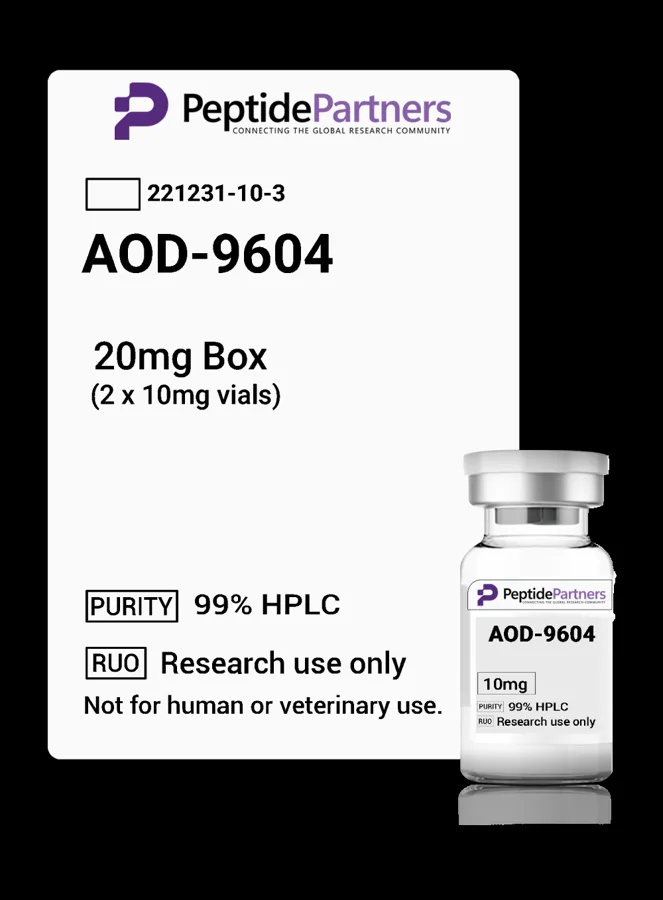
Laboratories frequently choose between single-vial offerings and multi-vial research packs depending on experimental design. Single vials are suitable for preliminary pilot assays, whereas multi-vial packs ensure that long-term, repeated-measures protocols maintain consistent batch chemistry. Because lyophilized peptides are sensitive to repeated freeze-thaw cycles once reconstituted in bacteriostatic or sterile water, sourcing smaller multi-vial formats allows researchers to prepare only the working volume required for specific assay runs, thereby preserving the integrity of the remaining stock.
Conclusion
AOD-9604 remains a significant focus of biochemical and metabolic research, offering an isolated molecular framework to study lipid catabolism, mitochondrial substrate utilization, and extracellular tissue dynamics without the confounding systemic actions of full-length growth hormone. For research teams conducting in vitro or in vivo experiments, maintaining scientific rigor demands high-purity materials, comprehensive analytical validation, and meticulous handling protocols.
Where to buy AOD-9604 for research
Peptides Partners lists AOD-9604 (10mg vials) in 3 pack sizes, all in stock, with price per mg shown for each option. Browse more mitochondrial compounds in the Peptides Partners research peptide shop. All products are for laboratory research use only.