
PEPTIDES PARTNERS BLOG · November 11, 2026
The Research Science of N-Acetyl Selank Amidate: Structural Modifications and Neurochemical Pathways
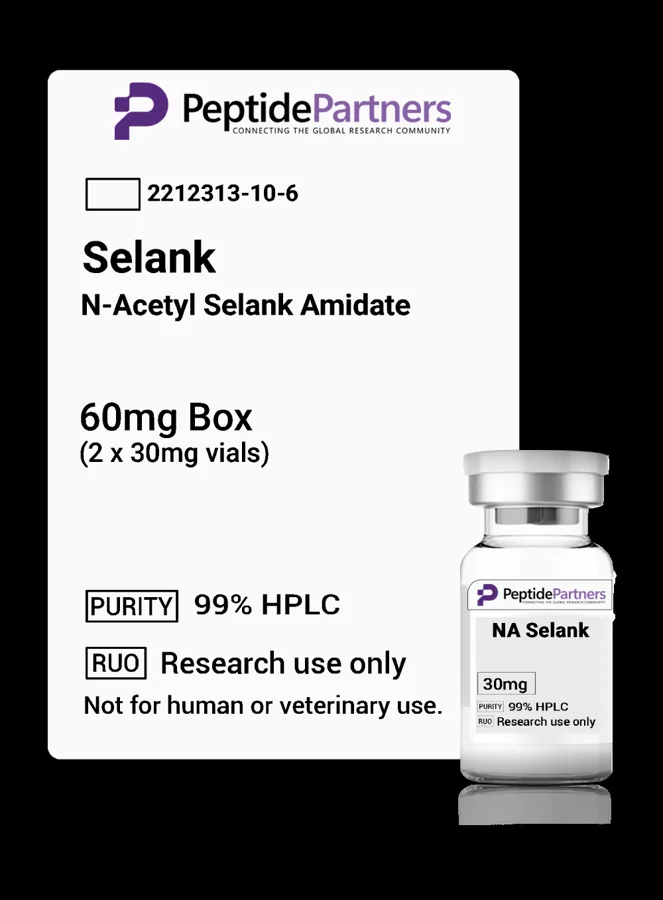
The study of synthetic peptide analogs has expanded rapidly over the past two decades, with particular focus on neuroactive sequences derived from endogenous regulatory molecules. Among these, Selank and its modified derivatives have garnered sustained interest across neurobiology and pharmacology laboratories. Investigated predominantly as a synthetic heptapeptide, Selank was designed to mimic and extend the biological actions of the natural immunomodulatory peptide tuftsin. In recent years, researchers investigating structural optimization have directed attention toward N-Acetyl Selank Amidate, a double-capped derivative modified at both termini. Available to the scientific community in standardized formats such as 30mg lyophilized vials, this compound serves as a primary model for exploring peptide stabilization, central neurotransmitter dynamics, and neurotrophic signaling in vitro and in vivo animal models.
Evolutionary Lineage: From Tuftsin to Amidated Selank
To understand the scientific interest in N-Acetyl Selank Amidate, one must examine its molecular ancestry. The parent structural motif originates from tuftsin, an endogenous tetrapeptide with the primary sequence Thr-Lys-Pro-Arg. Tuftsin is naturally cleaved from the Fc domain of immunoglobulin G (IgG) in the spleen and is historically recognized for its capacity to modulate phagocytosis, immune surveillance, and inflammatory cell signaling.
During the late 20th century, researchers at the Institute of Molecular Genetics of the Russian Academy of Sciences investigated ways to repurpose this immune peptide sequence for central nervous system investigations. By appending a stable Pro-Gly-Pro tripeptide to the C-terminus of tuftsin, scientists produced the linear heptapeptide known as Selank (Thr-Lys-Pro-Arg-Pro-Gly-Pro). The C-terminal extension improved metabolic stability against circulating proteases while conferring distinct neurotropic properties, providing a novel framework for studying the bidirectional communication between the immune and central nervous systems.
Molecular Architecture: N-Terminal Acetylation and C-Terminal Amidation
Linear peptides utilized in experimental research are inherently vulnerable to rapid degradation by endogenous exopeptidases. Aminopeptidases typically cleave free N-terminal residues, while carboxypeptidases target the unbound carboxyl terminus. To address these biological constraints in laboratory experiments, modern peptide chemists implement terminal protective modifications.
N-Acetyl Selank Amidate (Ac-Thr-Lys-Pro-Arg-Pro-Gly-Pro-NH2) incorporates two distinct synthetic alterations:
- N-Terminal Acetylation: The addition of an acetyl functional group (CH3CO-) to the N-terminus removes the positive charge of the free amine, mimicking a peptide bond and rendering the molecule resistant to aminopeptidase cleavage.
- C-Terminal Amidation: The replacement of the free carboxyl group (-COOH) with an amide group (-CONH2) neutralizes the negative charge, shielding the peptide backbone from carboxypeptidase activity.
In analytical pharmacology, these twin capping strategies are studied because they closely mirror post-translational modifications found in natural signaling hormones. Preclinical structural studies demonstrate that this dual protection enhances enzymatic half-life in biological matrices without disrupting the central spatial conformation required for receptor interactions.
Investigated Neurobiological Mechanisms
N-Acetyl Selank Amidate is categorized in experimental literature under the umbrella of nootropic and neuroregulatory research. Laboratory models explore its properties across several interconnected biological pathways:
1. GABAergic Allosteric Modulation
Preclinical electrophysiological and radioligand binding studies suggest that Selank-derived sequences modulate gamma-aminobutyric acid (GABA) transmission. Unlike conventional benzodiazepines, Selank does not appear to bind directly to the classic benzodiazepine binding pocket on the GABA-A receptor complex with high affinity. Instead, research indicates it acts via an allosteric modulatory site, altering receptor affinity and downstream chloride ion conductance under conditions of metabolic or psychological stress.
2. Neurotrophin Expression and Neuroplasticity
A central avenue of ongoing investigation is the impact of Selank analogs on neurotrophic factors. In animal models, administration of these peptide sequences has been studied for its ability to alter mRNA expression levels of Brain-Derived Neurotrophic Factor (BDNF) and its primary receptor, Tropomyosin receptor kinase B (TrkB), within the hippocampus and frontal cortex. These observations have made N-Acetyl Selank Amidate a reference compound for exploring molecular mechanisms governing synaptic remodeling, memory consolidation, and neuronal resilience.
3. Modulation of Endogenous Enkephalin Metabolism
Research indicates that Selank compounds inhibit carboxypeptidase H and enkephalin-degrading enzymes in vitro. By retarding the breakdown of endogenous enkephalins, the peptide sequence is studied for its indirect influence on opioid receptor systems and endogenous stress-response cascades, free from direct agonism at mu-opioid sites.
4. Serotonergic and Dopaminergic Turnover
Biochemical assays evaluating monoamine concentrations in rodent models reveal that Selank sequences influence serotonin (5-HT) and dopamine metabolism within distinct subcortical regions. Researchers measure levels of major metabolites, such as 5-hydroxyindoleacetic acid (5-HIAA) and dihydroxyphenylacetic acid (DOPAC), to evaluate how the compound shifts monoaminergic turnover during experimental cognitive tasks.
Experimental Comparison: Standard Selank vs. N-Acetyl Selank Amidate
When selecting experimental subjects for bench research, laboratories evaluate the functional parameters of different sequence iterations:
| Parameter | Native Selank | N-Acetyl Selank Amidate |
|---|---|---|
| Sequence | H-Thr-Lys-Pro-Arg-Pro-Gly-Pro-OH | Ac-Thr-Lys-Pro-Arg-Pro-Gly-Pro-NH2 |
| N-Terminus | Free amine (unprotected) | Acetylated (capped) |
| C-Terminus | Free carboxylic acid | Amidated (capped) |
| Enzymatic Susceptibility | Vulnerable to exopeptidases | High resistance to amino/carboxypeptidases |
| Analytical Focus | Baseline receptor binding and turnover | Extended-duration in vitro and in vivo assays |
Evaluating 30mg Formulations and Sourcing at Peptides Partners
For research teams procuring synthetic peptides through Peptides Partners (peptidespartners.co), working with an optimized 30mg vial format offers distinct procedural advantages for multi-phase laboratory protocols. When dealing with experimental heptapeptides, maintaining integrity across concentration curves requires careful assessment of product documentation and reconstitution characteristics.
Qualified research institutions evaluate several key parameters when sourcing N-Acetyl Selank Amidate 30mg vials:
- Analytical Verification: Reliable research data relies on strict peptide confirmation. Sourcing standards demand High-Performance Liquid Chromatography (HPLC) to confirm peptide purity and assess chromatographic peak symmetry, alongside Mass Spectrometry (MS) to verify precise molecular weight corresponding to the acetylated and amidated structural formula.
- Lyophilization Quality: High-grade 30mg vials should present as a uniform, white to off-white lyophilized cake or powder. The lyophilization cake structure indicates proper moisture removal, which directly governs shelf life and stability when stored at standard research temperatures (-20°C).
- Solubility Profiles: Because N-Acetyl Selank Amidate retains balanced hydrophilic and hydrophobic domains, it exhibits high solubility in sterile, bacteriostatic water or neutral laboratory buffers. Researchers calibrate working volumes to achieve specific stock concentrations (e.g., 5mg/mL or 10mg/mL) suitable for automated pipetting systems.
- Batch Consistency: Multi-vial packaging options at Peptides Partners allow laboratories to run longitudinal cellular or animal models without introducing variance between distinct synthetic runs.
Research-Use-Only Context
N-Acetyl Selank Amidate is synthesized and distributed strictly for non-clinical research and laboratory experimentation. It has not received regulatory approval from the U.S. Food and Drug Administration (FDA) or global health authorities for diagnostic, therapeutic, or human application. All investigations concerning this peptide must be confined to compliant in vitro assays, cell culture environments, and authorized preclinical experimental protocols designed to advance basic scientific knowledge in molecular neuroscience.
Where to buy N-Acetyl Selank Amidate 30mg vials for research
Peptides Partners lists N-Acetyl Selank Amidate 30mg vials in 4 pack sizes, all in stock, with price per mg shown for each option. Browse more nootropics compounds in the Peptides Partners research peptide shop. All products are for laboratory research use only.