
PEPTIDES PARTNERS BLOG · November 11, 2026
The Science of Cagrilintide: Mechanisms, History, and Analytical Standards in Metabolic Research
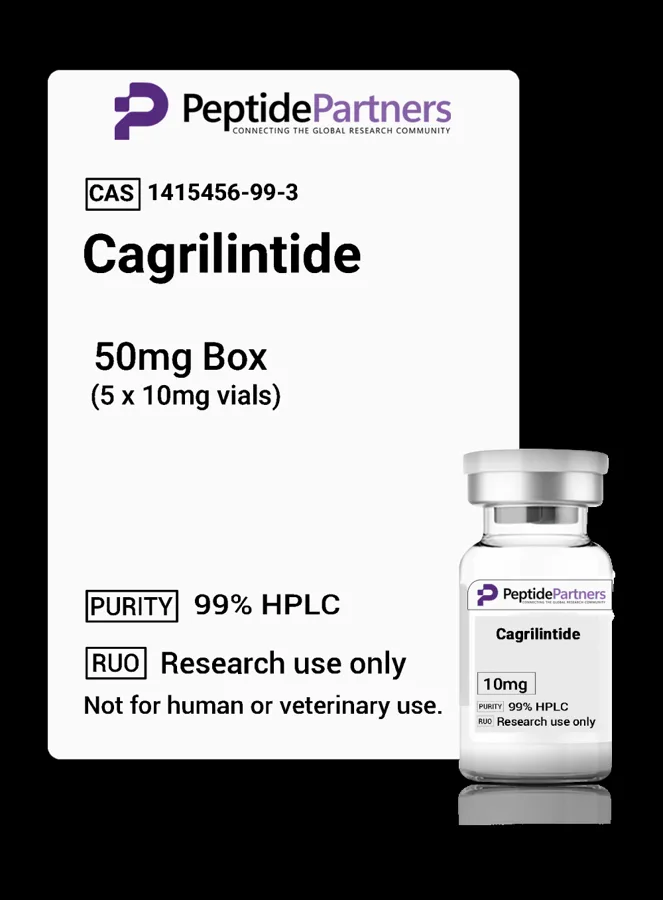
Metabolic research has evolved substantially over the past three decades, transitioning from broad phenotypic investigations to the precise molecular targeting of neuroendocrine signaling pathways. Central to this scientific progression is the exploration of physiological peptides that govern appetite, energy expenditure, and nutrient partitioning. While glucagon-like peptide-1 (GLP-1) and glucose-dependent insulinotropic polypeptide (GIP) pathways have garnered extensive scientific attention, amylin receptor agonism represents an equally critical frontier in metabolic biochemistry. At the forefront of this investigative domain is cagrilintide, a novel, long-acting acylated analog of human amylin. In modern laboratory settings, cagrilintide is extensively evaluated to decipher the multifaceted neurobiological systems that regulate caloric intake, body composition, and metabolic homeostasis.
Historical Context: From Native Amylin to Long-Acting Analogs
Human amylin, or islet amyloid polypeptide (IAPP), is a 37-amino-acid peptide co-secreted with insulin by pancreatic beta cells in response to nutrient ingestion. First identified in the late 1980s, native amylin was observed to work synergistically with insulin, helping to modulate postprandial glucose flux by delaying gastric emptying, suppressing postprandial glucagon secretion, and signaling satiety to the central nervous system. Despite its crucial biological role, native amylin posed severe limitations for long-term experimental research: its native structure is highly prone to self-aggregation into cytotoxic amyloid fibrils, and its biological half-life is exceptionally short, measured in minutes.
Early pharmaceutical chemistry addressed fibril formation through the development of pramlintide, an analog featuring proline substitutions at positions 25, 28, and 29. While pramlintide demonstrated that synthetic amylin mimetics could avoid aggregation, its short duration of action required frequent re-administration in experimental models, limiting its utility for chronic metabolic studies.
To overcome these pharmacokinetic boundaries, molecular researchers engineered cagrilintide. By modifying the primary peptide sequence and incorporating a hydrophobic fatty diacid side chain (lipidation), investigators created an analog capable of reversible, high-affinity binding to circulating albumin. This structural modification dramatically slows enzymatic clearance and renal elimination, extending the functional half-life to several days in animal models and human kinetic evaluations. As a result, cagrilintide has become an indispensable molecular tool for assessing sustained, long-term amylin receptor activation in controlled preclinical and clinical research paradigms.
Molecular Mechanisms and Receptor Pharmacology
The primary mechanism of cagrilintide involves non-selective agonism across all three major amylin receptor subtypes (AMYR1, AMYR2, and AMYR3), as well as direct binding to the calcitonin receptor (CTR). Amylin receptors are distinct from many conventional G protein-coupled receptors (GPCRs) because they are heterodimers formed by the co-assembly of the calcitonin receptor core with one of three receptor activity-modifying proteins (RAMP1, RAMP2, or RAMP3). Cagrilintide is designed to engage these receptor complexes with nanomolar potency.
In laboratory assays, binding of cagrilintide to AMYR complexes triggers intracellular cyclic adenosine monophosphate (cAMP) generation via adenylate cyclase stimulation. This downstream intracellular cascade primarily acts within circumventricular organs of the brain that lack a fully developed blood-brain barrier, most notably the area postrema (AP) and the adjacent nucleus of the solitary tract (NTS) in the caudal hindbrain.
Preclinical neuroimaging and tracing studies indicate that cagrilintide activates distinct neuronal subpopulations compared to GLP-1 receptor agonists. While GLP-1 signaling relies heavily on hypothalamic and vagal afferent pathways to influence satiety, amylin analogs directly engage area postrema neurons to induce homeostatic and hedonic satiety signals. Because these anatomical pathways diverge, researchers frequently investigate cagrilintide in combination with incretin mimetics, testing hypotheses surrounding synergistic neurochemical signaling, non-overlapping feedback loops, and amplified metabolic control.
Primary Areas of Laboratory Investigation
Researchers utilize cagrilintide across a broad spectrum of in vitro, ex vivo, and in vivo study designs. Published scientific literature has highlighted several primary domains of ongoing metabolic interest:
- Satiety Signaling and Nutrient Intake: Investigating the rate at which sustained AMYR agonism downregulates meal size, alters macronutrient preference, and attenuates hedonic food-seeking behaviors in rodent models of diet-induced obesity.
- Adiposity and Body Composition Dynamics: Assessing changes in visceral and subcutaneous fat depots relative to lean muscle preservation during prolonged caloric deficit induced by peptide administration.
- Synergistic Co-Agonism Models: Exploring pharmacodynamic interactions when cagrilintide is evaluated alongside GLP-1 analogs (such as semaglutide) or dual GIP/GLP-1 analogs (such as tirzepatide) to determine whether concurrent pathways yield additive metabolic outcomes without compromising biological tolerance.
- Gastric Motility and Glycemic Flux: Monitoring gastrointestinal transit time and its secondary effects on systemic glucose excursions, insulin sensitivity markers, and glucagon suppression in preclinical metabolic cages.
Sourcing Cagrilintide: Evaluating Documentation and Quality Controls
For scientific investigations to yield reproducible, peer-reviewable data, the chemical integrity of the synthesized peptide must be rigorously characterized. Cagrilintide is an intricate, acylated biomolecule, making it susceptible to synthesis errors such as truncated sequences, incomplete deprotection, or oxidative degradation. When sourcing reference materials from specialized chemical providers like Peptides Partners (peptidespartners.co), researchers must carefully evaluate comprehensive batch documentation.
Key analytical documentation to inspect prior to commencing experimental work includes:
- High-Performance Liquid Chromatography (HPLC): Confirms chromatographic purity by resolving the primary target peak from synthesis-related impurities, diastereomers, and degradation products.
- Mass Spectrometry (MS): Confirms structural identity by measuring the exact molecular weight, ensuring accurate chain length and appropriate covalent attachment of the fatty diacid moiety.
- Lyophilization Integrity: Ensures residual moisture and counter-ion levels (such as acetate or trifluoroacetate) fall within acceptable baseline parameters to prevent spontaneous degradation during frozen storage.
Comparing Vial Configurations and Pack Sizes for Laboratory Work
Selecting appropriate packaging configurations is a critical component of experimental design. Because reconstituted peptide solutions are susceptible to progressive degradation and structural alterations from repeated freeze-thaw cycles, matching the purchase volume to the intended assay workflow preserves experimental consistency.
| Configuration | Optimal Research Application | Primary Advantages |
|---|---|---|
| Single Vials (5 mg or 10 mg) | Method validation, preliminary in vitro binding assays, receptor affinity profiling. | Minimizes material waste during assay calibration; lower upfront investment for initial proof-of-concept testing. |
| Multi-Vial Packs (5-Pack) | Short-term in vivo dosing studies, dose-escalation paradigms, small cohort parallel testing. | Enables fresh reconstitution per experimental phase, avoiding extended liquid storage and potential biological loss. |
| Bulk Packs (10-Pack or higher) | Longitudinal animal trials, multi-arm combinatorial studies, batch-matched collaborative research. | Ensures that all treatment cohorts receive peptide from the same synthesis lot, eliminating inter-batch variability across months of data collection. |
Conclusion: The Future of Amylin Research
Cagrilintide represents a significant advancement in the study of neuroendocrine regulation and metabolic biology. By resolving the pharmacokinetic and physical limitations that historically constrained native amylin and short-acting mimetics, this long-acting acylated analog provides investigators with a reliable tool for exploring long-term AMYR signaling. As metabolic research increasingly investigates combinatorial therapies that span multiple physiological receptors, understanding the baseline biochemistry, signaling cascades, and analytical quality requirements of cagrilintide remains essential for researchers advancing the boundaries of metabolic science.
Where to buy Cagrilintide for research
Peptides Partners lists Cagrilintide (10mg vials) in 4 pack sizes, all in stock, with price per mg shown for each option. Browse more metabolics compounds in the Peptides Partners research peptide shop. All products are for laboratory research use only.