
PEPTIDES PARTNERS BLOG · November 11, 2026
The Research Science of Thymosin Alpha-1: History, Mechanisms, and Laboratory Sourcing
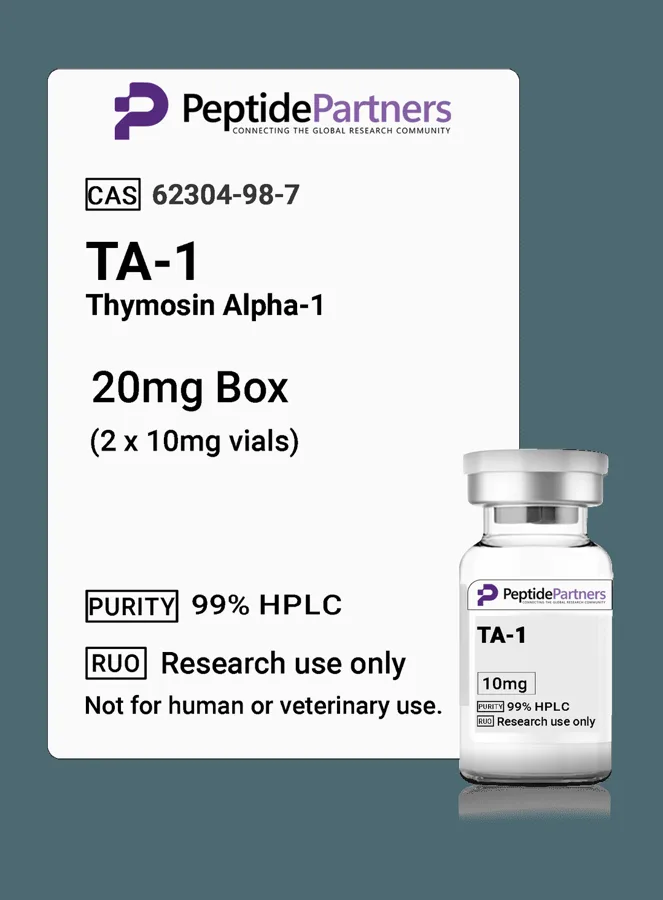
Introduction to Thymosin Alpha-1 in Immunological Research
Thymosin Alpha-1 (often abbreviated as Tα1) occupies a foundational position in the field of immunomodulatory peptide science. Originally identified as an active fraction derived from the thymus gland, this naturally occurring peptide fragment has been the subject of intensive academic and biomedical study for over five decades. Investigators explore Thymosin Alpha-1 primarily for its capacity to interact with innate and adaptive immune signaling cascades without triggering non-specific systemic inflammatory storms.
Within laboratory models, Thymosin Alpha-1 is categorized as a biological response modifier. Rather than acting as a direct cytotoxic agent or a synthetic immunosuppressant, research suggests that the peptide functions homeostatically, modulating immune cell expression, intracellular signaling pathways, and cytokine profiles depending on the physiological microenvironment. For scientists working across immunology, cellular biology, and oncology research, understanding the structural nuances, mechanistic pathways, and laboratory standards for sourcing Thymosin Alpha-1 is critical for ensuring reliable experimental data.
Historical Discovery and Molecular Structure
The discovery of Thymosin Alpha-1 traces back to the mid-1960s and early 1970s, spearheaded by Dr. Allan L. Goldstein and Dr. Abraham White at the Albert Einstein College of Medicine. Researchers were attempting to isolate the endocrine factors responsible for T-cell differentiation and maturation within the thymus gland. This work initially yielded a partially purified bovine thymus extract termed “Thymosin Fraction 5.”
Subsequent purification and sequencing identified Thymosin Alpha-1 as the primary bioactive peptide responsible for much of Fraction 5’s immunomodulatory activity. Chemically, Thymosin Alpha-1 is a 28-amino acid peptide with an acetylated N-terminus. Its sequence is identical across several mammalian species, highlighting an evolutionary conservation that has made it a versatile tool in comparative immunology. The primary sequence is synthesized in vivo from a larger precursor protein known as prothymosin alpha, which spans 109 to 111 amino acids.
Modern laboratory research no longer relies on animal organ extraction. Instead, experimental protocols employ synthetic Thymosin Alpha-1 produced via solid-phase peptide synthesis (SPPS). This synthetic approach produces a chemically pure, homogenous compound free from biological contaminants, viral pathogens, or cross-reactive peptide fragments inherent to animal-derived extracts.
Key Investigational Mechanisms and Intracellular Pathways
Biochemical research has characterized several distinct molecular pathways through which Thymosin Alpha-1 exerts its influence on cultured cells and animal tissue models:
Toll-Like Receptor (TLR) Signaling
Preclinical studies indicate that Thymosin Alpha-1 acts as an agonist for pattern recognition receptors, specifically Toll-like receptor 9 (TLR9) and, to a lesser extent, TLR2. Through TLR signaling in dendritic cells and myeloid lineages, the peptide stimulates a MyD88-dependent signaling pathway. This cascade leads to the activation and nuclear translocation of nuclear factor kappa B (NF-κB), subsequently promoting the transcription of key immunoregulatory genes.
T-Cell Differentiation and MHC-I Upregulation
A core focus of Thymosin Alpha-1 research involves its role in the differentiation of early thymocytes into mature CD4+ helper and CD8+ cytotoxic T lymphocytes. In vitro models demonstrate that exposure to Tα1 increases the cell-surface expression of Major Histocompatibility Complex (MHC) Class I molecules and beta-2 microglobulin. This upregulation facilitates improved antigen presentation and target recognition by cytotoxic lymphocytes.
Cytokine Orchestration and NK Cell Activation
Rather than driving uninhibited immune stimulation, research indicates that Thymosin Alpha-1 shifts the cytokine balance toward a Th1-mediated profile. Experimental models have documented increased production of interleukin-2 (IL-2), interferon-gamma (IFN-γ), and interleukin-12 (IL-12), accompanied by enhanced natural killer (NK) cell lytic activity. Concurrently, several studies have investigated the peptide’s ability to attenuate excessive inflammation by downregulating pro-inflammatory markers such as IL-6 and tumor necrosis factor-alpha (TNF-α) in septic shock or cytokine release models.
Primary Areas of Research Interest
Thymosin Alpha-1 has been investigated across a spectrum of pre-clinical and clinical research disciplines. Scientists consistently assess its activity in the following experimental domains:
- Viral Pathogen Models: Research has explored how Tα1 modulates host defense responses against persistent viral infections, evaluating its influence on viral clearance rates and cytotoxic lymphocyte engagement in hepatitis and respiratory viral platforms.
- Oncological Microenvironments: In cancer biology, researchers study the peptide as a potential adjunct to mitigate tumor-induced immune suppression. Studies explore whether Tα1 can counteract immune checkpoint evasion or augment the efficacy of cellular therapies.
- Sepsis and Critical Care Immunology: Investigations into endotoxemia and polymicrobial sepsis models examine whether Thymosin Alpha-1 can reverse the immune paralysis or lymphocyte apoptosis frequently observed in severe systemic stress states.
- Vaccine Adjuvant Investigations: Because of its ability to enhance dendritic cell maturation and antigen presentation, investigators frequently assess the peptide’s utility as a co-administered adjuvant in novel vaccine development.
Sourcing Research-Grade Peptides: Quality and Documentation
When procuring Thymosin Alpha-1 for scientific inquiry, analytical validation is critical. Reliable in vitro assays and reproducible animal models depend entirely on chemical consistency, identity verification, and structural integrity. Researchers sourcing compounds from providers like Peptides Partners must carefully evaluate technical documentation before integrating vials into laboratory workflows.
Analytical Testing and Documentation
Standard laboratory verification requires access to comprehensive batch-specific documentation. Investigators should look for two primary analytical readouts:
- High-Performance Liquid Chromatography (HPLC): Confirms chemical purity by separating the primary peptide from synthesis deletion sequences, truncated fragments, and residual synthesis solvents.
- Mass Spectrometry (MS): Confirms molecular identity by establishing the exact molecular weight (monoisotopic and average mass) of the 28-amino acid sequence, verifying that the compound matches theoretical expectations.
Comparing Vial Configurations for Study Design
Study parameters dictate the optimal format for sourcing research peptides. At Peptides Partners, researchers can choose between individual vials and multi-vial packs depending on experimental scale:
| Format Configuration | Primary Laboratory Utility | Workflow Advantages |
|---|---|---|
| Single Vials (e.g., 5mg or 10mg) | Pilot studies, assay calibration, in vitro baseline titrations | Minimizes material waste; ideal for preliminary methodological validation |
| Multi-Vial Packs (5-Pack / 10-Pack) | Longitudinal animal cohorts, multi-plate assays, parallel replicates | Ensures inter-assay consistency by using identical synthetic lot numbers across time points |
Laboratory Handling, Reconstitution, and Storage Protocols
Thymosin Alpha-1 is supplied as a lyophilized (freeze-dried) powder to maximize shelf-life stability. Proper handling protocols must be maintained within the laboratory to prevent peptide denaturation, oxidation, or microbial contamination:
- Lyophilized Storage: Unopened vials should be stored at -20°C for short-to-medium term research, or at -80°C for extended archival preservation. Vials should be allowed to equilibrate to room temperature before opening to avoid moisture condensation inside the container.
- Reconstitution Considerations: Depending on the experimental assay, reconstitution is typically performed using sterile bacteriostatic water for multi-use laboratory setups or sterile saline/phosphate-buffered saline (PBS) for immediate cell culture applications. Reagents should be introduced gently along the interior glass wall to avoid vigorous foaming, which can disrupt secondary structural conformation.
- Aliquoting and Freeze-Thaw Avoidance: Following reconstitution, solutions should be divided into single-use microcentrifuge aliquots and stored at -20°C or -80°C. Repeated freeze-thaw cycles must be strictly avoided, as physical phase changes induce aggregation and peptide fragmentation, compromising quantitative analytical results.
Conclusion
Thymosin Alpha-1 remains one of the most rigorously evaluated immunomodulatory peptides in contemporary biomedical science. Its capacity to balance immune responses via TLR-mediated signaling, cytokine regulation, and T-cell activation makes it an indispensable tool for research into immune dysfunction, infection, and oncology. To ensure the integrity of published findings, research institutions must prioritize verified analytical standards, transparent batch documentation, and strict physical handling procedures when working with research-grade materials.
Where to buy Thymosin Alpha-1 for research
Peptides Partners lists Thymosin Alpha-1 (TA1, 10mg vials) in 3 pack sizes, all in stock, with price per mg shown for each option. Browse more immunomodulatory compounds in the Peptides Partners research peptide shop. All products are for laboratory research use only.