
PEPTIDES PARTNERS BLOG · November 11, 2026
The Research Science of the KLOW Blend: Investigating BPC-157, TB-500, GHK-Cu, and KPV
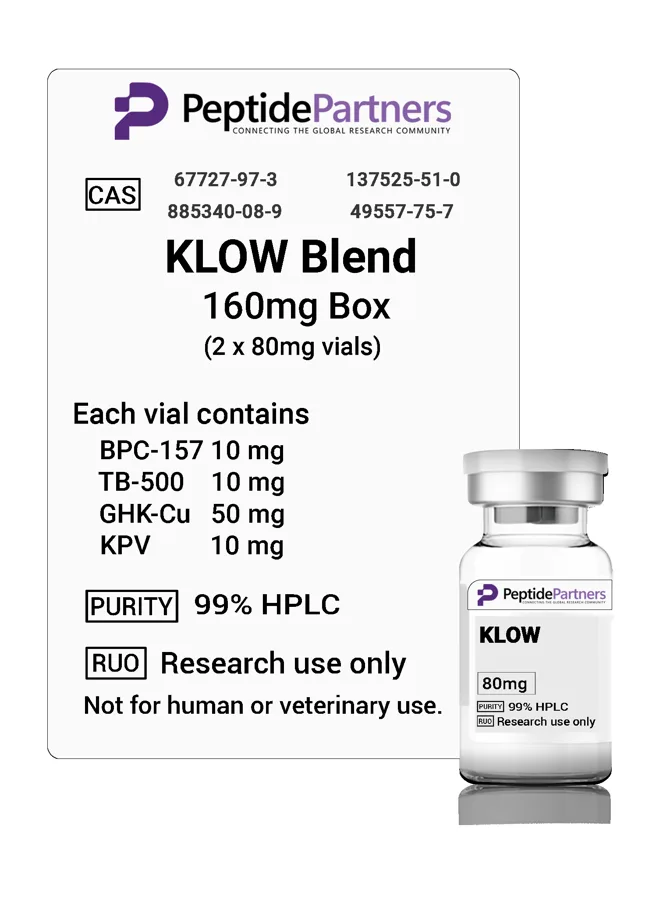
In contemporary biochemical research, peptide combinations have gained significant interest among laboratory investigators exploring cellular signaling, extracellular matrix remodeling, and oxidative stress pathways. Among these experimental formulations is the KLOW blend—a synergistic composite combining four extensively documented synthetic sequences: BPC-157, TB-500, GHK-Cu, and KPV. Classified within the broader catalog of antioxidant and tissue biology research reagents, this multi-peptide preparation allows researchers to study complex, overlapping physiological pathways in vitro and in non-human in vivo models. All constituents of this formulation are strictly intended for laboratory experimentation and non-clinical research use.
Origins and Discovery of the Constituents
Each constituent within the KLOW blend possesses a distinct lineage in biochemical discovery, originating from diverse biological sources before being adapted for synthetic laboratory evaluation.
- BPC-157 (Body Protection Compound-157): Derived from a 15-amino-acid segment of human gastric juice protein (BPC), this stable pentadecapeptide was first isolated during investigations into endogenous gastrointestinal cytoprotection. Preclinical research has consistently examined its structural resilience in acidic environments and its activity across various tissue explants.
- TB-500: A synthetic derivative representing the active domain (amino acids 17–23) of Thymosin Beta-4, a ubiquitous 43-amino-acid actin-sequestering protein initially isolated from calf thymus tissue. TB-500 was developed to investigate the specific biological properties of the parent peptide, notably its involvement in cell migration and cytoskeletal organization.
- GHK-Cu (Glycyl-L-Histidyl-L-Lysine Copper Complex): First isolated in 1973 by Dr. Loren Pickart from human plasma fractions, this naturally occurring tripeptide possesses a high affinity for copper(II) ions. Early comparative studies noted its concentrations decline with biological age, prompting sustained academic focus on its role in collagen gene expression and endogenous antioxidant defense mechanisms.
- KPV: Representing the C-terminal tripeptide (Lysine-Proline-Valine) of alpha-Melanocyte-Stimulating Hormone (α-MSH), KPV retains the anti-inflammatory signaling potential of its parent proopiomelanocortin (POMC) hormone without engaging melanocortin receptors responsible for pigment alteration.
Investigated Mechanisms and Cellular Targets
The core scientific appeal of the KLOW blend lies in the intersecting molecular cascades governed by each peptide. When combined in an experimental model, these sequences present researchers with an opportunity to observe cross-talk between multiple physiological axes.
Antioxidant Regulation and Redox Homeostasis
GHK-Cu and KPV are frequently evaluated for their influence on cellular redox dynamics. GHK-Cu has been shown in laboratory studies to downregulate pro-oxidant states by quenching lipid peroxidation products and modulating the transcription of superoxide dismutase (SOD) and catalase. In parallel, KPV has been investigated for its capacity to suppress intracellular reactive oxygen species (ROS) accumulation through the inhibition of nuclear factor kappa B (NF-κB) translocation, offering a distinct mechanism of action within cellular stress models.
Cytoskeletal Remodeling and Angiogenic Signaling
TB-500 acts primarily through the regulation of actin polymerization, sequestering G-actin monomers to facilitate cellular motility, endothelial cell reorganization, and migration across cellular matrices. Simultaneously, BPC-157 has been explored in preclinical literature for its interaction with the nitric oxide (NO) system and the vascular endothelial growth factor (VEGF) signaling pathway, frequently evaluated in models measuring capillary tube formation and cellular recruitment to damaged tissue matrices.
Matrix Integrity and Gene Expression
Research across cellular models indicates that GHK-Cu and BPC-157 exert measurable effects on the transcription of extracellular matrix (ECM) components. GHK-Cu has demonstrated regulatory control over both matrix metalloproteinases (MMPs) and their tissue inhibitors (TIMPs), balancing collagen synthesis and degradation. BPC-157 has been documented to modulate early growth response-1 (Egr-1) gene expression, illustrating a multi-tiered regulatory influence on structural protein synthesis.
The Scientific Rationale for Multi-Peptide Investigation
In standard biochemical screening, single-agent models often fail to replicate the complex feedback loops present in living systems. By studying a composite peptide matrix such as KLOW, researchers can interrogate multi-factorial endpoints—such as the balance between inflammatory signaling, angiogenic triggers, and structural matrix scaffolding—within a single experimental protocol. Understanding how these separate peptides influence one another’s pharmacodynamics and receptor affinity remains a productive area of ongoing biochemical literature.
Comparing Research Configurations: Single Vials vs. Multi-Vial Packs
When designing experimental timelines, researchers must evaluate packaging formats to ensure stability, minimize reconstitution loss, and maintain analytical reproducibility across serial assays. Peptides Partners provides the KLOW blend in different configurations to suit diverse operational scales.
| Configuration | Optimal Research Context | Key Methodological Advantage |
|---|---|---|
| Single Vials | Proof-of-concept assays, baseline cross-reactivity testing, exploratory titration. | Minimizes material storage duration and avoids waste during short-term trials. |
| Multi-Vial Packs (5-Pack) | Mid-scale cellular culture series, replicated matrix degradation trials. | Allows identical reconstituted concentration batches across parallel test groups. |
| Bulk Packs (10-Pack+) | Longitudinal animal model studies, automated high-throughput assays. | Eliminates inter-batch lot variation over prolonged investigation periods. |
Quality Control and Analytical Documentation at Peptides Partners
The integrity of experimental outcomes depends fundamentally on the chemical identity and purity of the research materials used. Peptides Partners prioritizes chemical verification, ensuring that every batch of the KLOW blend adheres to rigorous analytical parameters before entry into the research supply chain.
Every lot is subjected to dual-method verification involving High-Performance Liquid Chromatography (HPLC) and Mass Spectrometry (MS). HPLC analysis confirms the chromatographic purity of the mixture, verifying the absence of secondary truncation sequences or chemical degradation products. Electrospray Ionization Mass Spectrometry (ESI-MS) or MALDI-TOF is concurrently deployed to validate the precise molecular mass of each of the four peptide constituents (BPC-157, TB-500, GHK-Cu, and KPV).
When sourcing through Peptides Partners, laboratories are provided with comprehensive analytical documentation. Investigators can verify batch-specific data, verifying that the lyophilized matrix contains minimal residual moisture, low trifluoroacetic acid (TFA) salt levels, and verified molar ratios, thereby preventing confounding variables in cell-viability assays or downstream spectroscopy.
Conclusion
The KLOW blend stands at the intersection of redox biology, structural proteomics, and cellular signaling research. By combining the distinctive properties of BPC-157, TB-500, GHK-Cu, and KPV into an analytically defined format, it serves as a valuable tool for investigators modeling tissue mechanics, inflammation pathways, and antioxidant kinetics in controlled laboratory environments.
Where to buy KLOW Blend: BPC-157/TB-500/GHK-Cu/KPV for research
Peptides Partners lists KLOW Blend: BPC-157/TB-500/GHK-Cu/KPV (80mg vials) in 3 pack sizes, all in stock, with price per mg shown for each option. Browse more anti-oxidant compounds in the Peptides Partners research peptide shop. All products are for laboratory research use only.