
PEPTIDES PARTNERS BLOG · November 11, 2026
The Research Science of Sermorelin: Discovery, Mechanisms, and Laboratory Sourcing
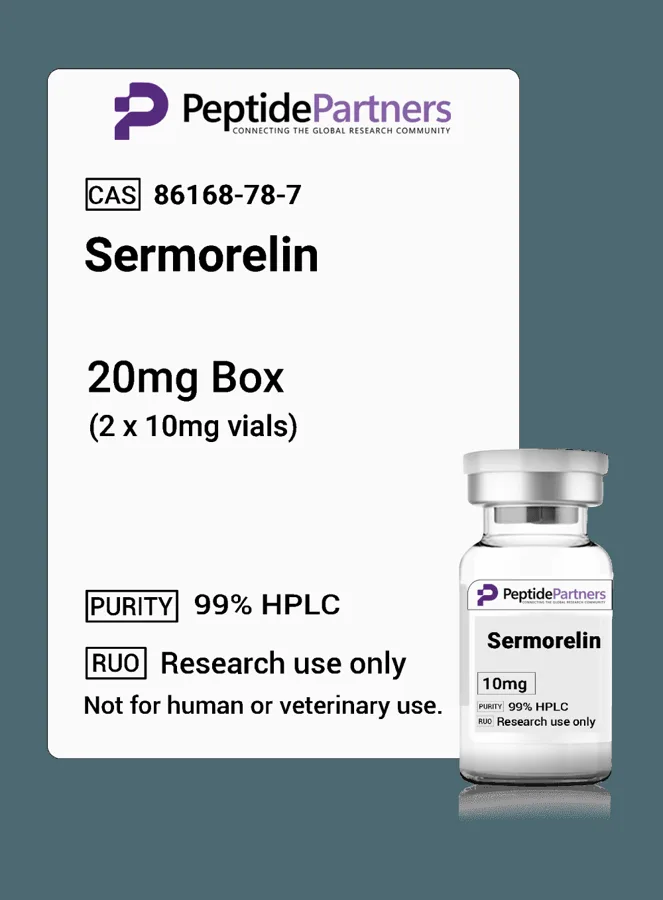
Within the expanding field of metabolic research, growth hormone secretagogues and hypothalamic peptide analogs represent an essential area of study. Among these molecular candidates, Sermorelin has occupied a prominent place in laboratory investigations for decades. Classified chemically as an analog of human growth hormone-releasing hormone (GHRH), Sermorelin serves as a valuable tool for scientists exploring the pituitary axis, cellular metabolism, endocrine signaling cascades, and tissue regeneration models.
For scientific investigators acquiring peptides through catalogs like Peptides Partners, understanding the biochemical foundations of Sermorelin, its historical context, and the technical criteria required for analytical evaluation is essential to executing reproducible experimental designs.
Historical Milestones in GHRH and Sermorelin Discovery
The physiological regulation of the anterior pituitary gland remained a major endocrine mystery until the mid-to-late 20th century. Nobel laureates Roger Guillemin and Andrew Schally spearheaded pioneering work in the 1970s and 1980s that characterized the hypothalamic factors governing anterior pituitary hormone release. Native GHRH was ultimately isolated and sequenced in 1982 from pancreatic islet tumors causing acromegaly, revealing a full-length peptide consisting of 44 amino acids (GHRH 1-44-NH2).
Subsequent structure-activity relationship (SAR) research demonstrated that the entire 44-amino-acid sequence was not necessary for binding affinity or biological signaling. Truncation experiments determined that the first 29 amino acids from the N-terminal region retained full intrinsic potency and receptor specificity. This 29-amino-acid sequence, designated chemically as GHRH (1-29) amide, was standardized as Sermorelin. The development of Sermorelin provided researchers with a stable, synthetically accessible peptide fragment capable of activating the hypothalamic-pituitary-somatotropic axis with greater efficiency than the native 44-residue peptide.
Molecular Architecture and Receptor Signaling Mechanisms
Sermorelin consists of the primary sequence Tyr-Ala-Asp-Ala-Ile-Phe-Thr-Asn-Ser-Tyr-Arg-Lys-Val-Leu-Gly-Gln-Leu-Ser-Ala-Arg-Lys-Leu-Leu-Gln-Asp-Ile-Met-Ser-Arg-NH2, featuring an amidated C-terminus that provides structural resistance against enzymatic degradation by exopeptidases. In biological research models, Sermorelin operates via targeted interaction with specific membrane-bound receptors on pituitary somatotrophs.
The GHRH Receptor Pathway
In vitro investigations have mapped the precise intracellular signaling cascade triggered by Sermorelin binding to the G-protein coupled GHRH receptor (GHRHR):
- Receptor Association: Sermorelin binds to the extracellular domain of the GHRHR on anterior pituitary cells.
- Adenylate Cyclase Activation: This binding facilitates coupling to the Gs alpha subunit, activating adenylate cyclase.
- cAMP Generation: Intracellular cyclic adenosine monophosphate (cAMP) levels elevate rapidly.
- Protein Kinase A Induction: Elevated cAMP stimulates protein kinase A (PKA), which phosphorylates the transcription factor CREB (cAMP response element-binding protein).
- Vesicle Translocation and Gene Expression: PKA signaling opens voltage-dependent L-type calcium channels, driving the exocytosis of preformed growth hormone (GH) secretory vesicles while simultaneously upregulating transcription of the GH gene.
Unlike exogenous recombinant hormones or ghrelin mimetics (such as GHRPs), Sermorelin acts strictly through the physiological GHRH receptor pathway. Consequently, laboratory models demonstrate that its activity remains subject to negative feedback loops, including somatostatin release and local insulin-like growth factor-1 (IGF-1) concentrations, making it a critical focus for studying natural homeostatic preservation.
Comparative Overview: Sermorelin vs. Native GHRH
To contextualize its widespread use in biochemical research, Sermorelin can be compared directly to native hypothalamic GHRH across several structural and functional parameters:
| Characteristic | Native GHRH (1-44) | Sermorelin (GHRH 1-29 Amide) |
|---|---|---|
| Sequence Length | 44 Amino Acids | 29 Amino Acids |
| Functional Domain | N-terminal active region with C-terminal tail | N-terminal core receptor-binding sequence |
| Molecular Weight | ~5039.7 Da | ~3357.9 Da |
| Receptor Specificity | GHRH-R (Pituitary Somatotrophs) | GHRH-R (Pituitary Somatotrophs) |
| Intrinsic Activity | Full agonist | Full agonist (equipotent to native peptide) |
| Feedback Sensitivity | Modulated by somatostatin | Modulated by somatostatin |
Metabolic and Biological Pathways Under Investigation
In modern preclinical research, Sermorelin is applied across a wide range of metabolic paradigms. Researchers study its capacity to modulate downstream endocrine markers and cellular pathways without overriding central regulatory systems.
Lipid and Glucose Metabolism
Studies evaluating rodent models of metabolic syndrome frequently utilize Sermorelin to analyze shifts in substrate utilization. Somatotropic activation triggers downstream lipolytic cascades, and researchers examine changes in adipose tissue gene expression, circulating free fatty acids, and baseline insulin sensitivity metrics.
Nitrogen Retention and Muscle Proteomics
Preclinical models of catabolic states explore how Sermorelin affects nitrogen balance, amino acid uptake, and protein synthesis in skeletal muscle tissue. Downstream signaling mediated by local and hepatic IGF-1 transcription serves as an established readout for these investigations.
Cardioprotective and Tissue Repair Models
Beyond endocrine signaling, research groups have evaluated GHRH analogs in non-pituitary tissue cultures. Functional GHRH receptors have been identified in cardiac myocytes, endothelial tissue, and fibroblasts. Preclinical studies investigate whether Sermorelin exposure influences cell viability, extracellular matrix remodeling, and angiogenesis following simulated ischemic injury.
Sourcing Sermorelin for Laboratory Research: Formats and Documentation
Executing valid, reproducible research requires strict attention to peptide sourcing standards. Experimental failure frequently stems not from flawed hypothesis design, but from variability in peptide purity, salt content, or mass discrepancies.
Evaluating Analytical Documentation
When selecting Sermorelin from Peptides Partners, researchers must verify that the material is accompanied by batch-specific analytical testing:
- High-Performance Liquid Chromatography (HPLC): Confirms chromatographic purity by verifying that the primary target peak corresponds to the theoretical yield, ensuring freedom from truncated or deleted synthesis artifacts.
- Mass Spectrometry (MS): Confirms molecular weight identity, verifying that the sample exhibits the precise mass calculation (~3357.9 Da) expected for the amidated 29-residue sequence.
Comparing Vial Packs for Study Workflows
Laboratory workflows require different vial allocations depending on assay throughput. When sourcing research materials, investigators should consider:
- Single-Vial Allotments: Suitable for initial characterization, assay validation, or small-scale cell culture pilots.
- Multi-Vial Packs (5-pack, 10-pack): Recommended for longitudinal animal studies or multi-timepoint in vitro assays. Reconstituted peptides are prone to gradual degradation in aqueous solutions; utilizing individual vials across successive experimental phases minimizes the need for repeated freeze-thaw cycles and preserves sample integrity.
Laboratory Storage and Handling
Sermorelin is supplied as a lyophilized white powder for research use only. Lyophilized peptides must be stored at sub-zero temperatures (typically -20°C or below), protected from light and moisture. Following reconstitution with appropriate laboratory diluents (such as sterile bacteriostatic water or saline), aliquots should be preserved at stable refrigerated temperatures for immediate testing or flash-frozen according to standard laboratory protocol.
Where to buy Sermorelin for research
Peptides Partners lists Sermorelin (10mg vials) in 4 pack sizes, all in stock, with price per mg shown for each option. Browse more metabolics compounds in the Peptides Partners research peptide shop. All products are for laboratory research use only.