
PEPTIDES PARTNERS BLOG · November 11, 2026
The Research Science of PT-141: Mechanisms, Discovery, and Laboratory Sourcing
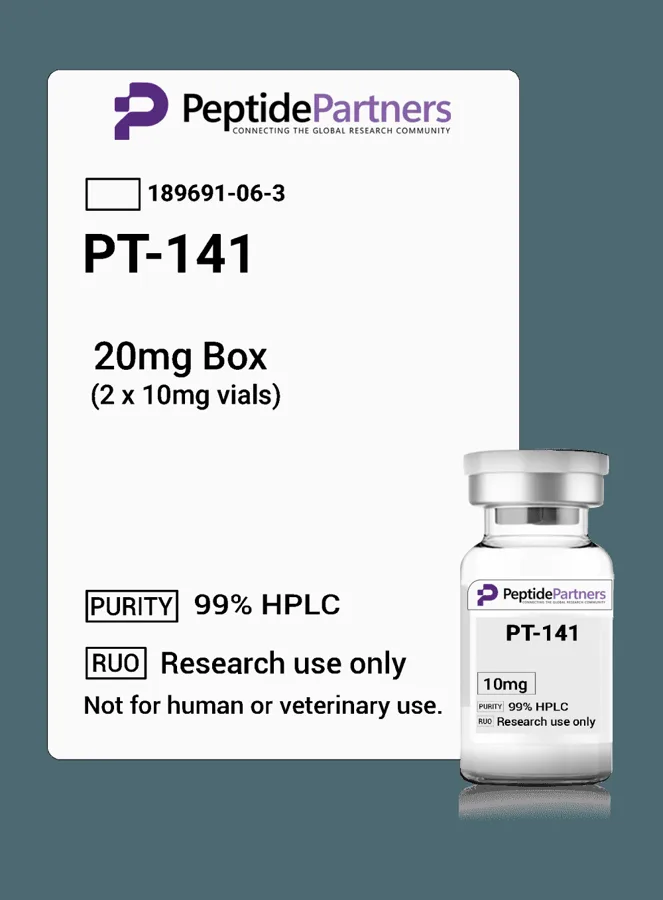
PT-141, known in the scientific literature as bremelanotide, represents a prominent focal point in peptide research targeting the central nervous system and peripheral vascular responses. Classified under the broad umbrella of neuroendocrine and vasoactive research peptides, PT-141 is a synthetic cyclic heptapeptide analog of alpha-melanocyte-stimulating hormone (α-MSH). Unlike traditional vasoactive agents that alter vascular tone primarily through localized enzymatic or endothelial pathways, PT-141 operates through central neurochemical mechanisms. Research teams worldwide study this molecule to better understand melanocortin receptor subtype binding, central regulation of autonomic functions, and downstream vascular dynamics in experimental models.
The Discovery and Structural Evolution of PT-141
The development of PT-141 emerged directly from early investigations into synthetic melanocortin receptor agonists conducted at the University of Arizona during the late 1980s and 1990s. Investigators were originally seeking synthetic analogs of naturally occurring α-MSH capable of stimulating melanogenesis as a potential photoprotective mechanism against ultraviolet radiation. One of the synthetic compounds derived from this work was Melanotan II (MT-II).
During initial laboratory evaluations of MT-II, investigators noted unexpected central autonomic effects that went beyond pigmentation. These observations prompted medicinal chemists to isolate and refine the active structure to separate tanning activity from central neurological and hemodynamic responses. By metabolically truncating the structure and modifying the terminal sequences, researchers synthesized PT-141: a cyclic lactam heptapeptide with the sequence Ac-Nle-cyclo[Asp-His-D-Phe-Arg-Trp-Lys]-OH. This molecular reconfiguration substantially diminished affinity for melanocortin 1 receptors (MC1R)—which govern skin pigmentation—while preserving active binding to melanocortin 3 and melanocortin 4 receptors (MC3R and MC4R), primarily situated within central nervous system pathways.
Receptor Specificity and Central Signaling Mechanisms
In preclinical and cellular models, the biological activity of PT-141 is primarily mediated via G-protein-coupled melanocortin receptors. The affinity profile of PT-141 shows specific engagement with:
- Melanocortin 4 Receptor (MC4R): Broadly expressed throughout the central nervous system, particularly in the hypothalamus (paraventricular nucleus, ventromedial nucleus) and the medial preoptic area. MC4R activation has been widely studied in connection with autonomic modulation, metabolic tone, and behavioral activation.
- Melanocortin 3 Receptor (MC3R): Implicated in energy homeostasis, circadian rhythms, and neuroendocrine regulation.
- Melanocortin 1 Receptor (MC1R): Exhibits reduced affinity relative to MT-II, reducing downstream melanogenic pathway signaling in comparative laboratory studies.
When PT-141 binds to central MC4R targets, it triggers intracellular cyclic adenosine monophosphate (cAMP) production via adenylate cyclase activation. Published animal models demonstrate that this signaling cascade influences downstream dopaminergic and oxytocinergic pathways. Rather than acting directly as a vasodilator on isolated smooth muscle tissue, PT-141 mediates vasoactive and behavioral responses through central hypothalamic and brainstem relays, making it a critical tool for researchers studying the intersection between neurobiology and peripheral vascular control.
Preclinical Themes: Vasoactive Dynamics and Behavioral Modulation
Research involving PT-141 spans several decades and multiple experimental paradigms. A significant portion of published literature focuses on the following research themes:
Central Autonomic and Hemodynamic Control
Because melanocortin signaling interacts with sympathetic nervous system tone, preclinical trials have evaluated the vasoactive profile of PT-141. Investigators have documented transient, dose-dependent variations in arterial blood pressure and heart rate in rodent and canine models. Understanding how central MC4R activation translates into peripheral vascular changes allows researchers to map the central control centers responsible for vascular tone and systemic perfusion.
Neurobehavioral Activation
PT-141 has been extensively evaluated in animal models exploring motivational behavior, social interaction, and appetitive responses. By microinjecting the peptide into precise cerebral regions (such as the medial preoptic area), neuroscientists have mapped the localized neural circuits governing autonomic excitement and neuroendocrine response profiles.
Evaluating Analytical Documentation for Research Peptides
To produce reproducible data, research facilities must ensure that the synthesized reagents meet strict chemical specifications. When sourcing PT-141 from research catalogs such as Peptides Partners, laboratory personnel should systematically evaluate the analytical documentation accompanying each lot:
- High-Performance Liquid Chromatography (HPLC): Confirms chemical purity by identifying the retention time and quantifying any related peptide impurities or synthesis degradation products.
- Mass Spectrometry (MS): Confirms identity by verifying the exact molecular mass (PT-141 has a chemical formula of C50H68N14O10 and an average molecular weight of approximately 1025.18 g/mol).
- Lyophilization Quality: High-vacuum lyophilization removes residual synthesis solvents, yielding a stable, sterile cake that facilitates consistent reconstitution in experimental buffers.
Selecting Vial Formats and Quantities at Peptides Partners
Research design dictates the appropriate procurement volume and packaging configuration. Because repeated freeze-thaw cycles can degrade peptide bonds and compromise experimental integrity, choosing the correct vial pack size is critical for maintaining consistency throughout a project.
| Format Configuration | Recommended Study Scale | Experimental Benefit |
|---|---|---|
| Single-Vial Units | Pilot studies, assay calibration, receptor binding screening | Minimizes reagent waste during protocol optimization and baseline testing. |
| 5-Vial Packs | Medium-scale preclinical cohorts, comparative dose-response assays | Provides batch consistency across duplicate cohorts without premature reconstitution. |
| 10-Vial Packs | Longitudinal animal models, multi-stage receptor mapping series | Ensures identical synthesis lot parameters across prolonged laboratory timelines. |
Laboratory Handling, Reconstitution, and Storage Standards
PT-141 is supplied as a lyophilized powder strictly intended for in vitro experimentation and laboratory research use. Maintaining its physical and chemical integrity requires standard peptide laboratory practices. The dry powder should be stored at controlled low temperatures (typically -20°C) protected from direct light and atmospheric moisture.
For experimental preparation, lyophilized vials should be allowed to equilibrate to room temperature before opening to avoid condensation. Depending on the assay protocol, sterile laboratory-grade bacteriostatic water or physiological saline is introduced carefully down the vial wall to prevent agitation-induced foaming. Once reconstituted, stock solutions are generally maintained at 2°C to 8°C for short-term experimentation or aliquoted into sterile microcentrifuge tubes and stored at -80°C to prevent peptide cleavage from repeated thermal cycling.
Through its unique profile as a central melanocortin agonist with secondary vasoactive downstream effects, PT-141 remains an essential reference peptide for investigating the molecular interfaces connecting central neurochemical signaling, autonomic activity, and vascular dynamics.
Where to buy PT-141 for research
Peptides Partners lists PT-141 (10mg vials) in 3 pack sizes, all in stock, with price per mg shown for each option. Browse more vasoactive compounds in the Peptides Partners research peptide shop. All products are for laboratory research use only.