
PEPTIDES PARTNERS BLOG · November 11, 2026
The Research Science of B1: Mechanisms, History, and Experimental Sourcing Standards
Introduction to B1 Peptide Research in Molecular Biology
Peptide sequences classified under the B1 designation, most notably those interacting with the Bradykinin B1 receptor system and related peptide signaling cascades, represent a fundamental focus within cellular biology, pharmacology, and physiological modeling. In biological systems, peptide ligands designed to engage specific cell-surface receptors provide critical insights into signal transduction, inflammatory modulation, vascular permeability, and tissue homeostasis. Within contemporary laboratory settings, synthesized B1 peptide probes are utilized strictly for in vitro assays, biochemical profiling, and preclinical animal models to map precise cellular pathways.
Because synthetic peptide tools must function with high fidelity across controlled experiments, researchers analyze these molecules to determine binding kinetics, downstream enzymatic activation, and structural degradation pathways. Understanding the foundation of B1 peptide research requires examining the historical identification of the pathway, the physiological mechanisms currently under investigation, and the practical parameters necessary for laboratory procurement.
Historical Discovery and the Evolution of the B1 Receptor Model
The conceptual framework for the B1 signaling system originated from classical work on the kallikrein-kinin pathway during the mid-twentieth century. Early physiologists identified kinin peptides as potent modulators of smooth muscle contraction and vascular dilation. However, it was not until the late 1970s that pharmacologists, led by researchers such as Domenico Regoli and colleagues, formally categorized kinin receptors into distinct subtypes: B1 and B2.
A central scientific breakthrough was the recognition of the contrasting expression patterns between these two receptor classes. While the B2 receptor is constitutively expressed across diverse mammalian tissues and mediates immediate responses to native kinins like bradykinin, the B1 receptor exhibits low baseline expression under normal physiological conditions. Instead, preclinical investigations established that B1 receptor expression is predominantly inducible, upregulating significantly in response to cellular stress, tissue injury, and pro-inflammatory signaling molecules such as interleukin-1 beta (IL-1beta) and tumor necrosis factor-alpha (TNF-alpha).
This discovery shifted the focus of molecular biology toward the design of specialized B1 peptide agonists and antagonists. By synthesizing peptide analogs characterized by specific amino acid substitutions or terminal truncations (such as des-Arg-kinin derivatives), researchers gained the ability to selectively probe the inducible arm of the kinin cascade without co-activating constitutive B2 pathways.
Biochemical Mechanisms and Pathways Under Investigation
Research involving B1 peptides centers on their role as targeted molecular ligands interacting with specific G-protein coupled receptors (GPCRs). The signaling cascades initiated upon ligand-receptor binding activate several major downstream pathways studied extensively in cell cultures and animal models:
- Phospholipase C (PLC) Activation: Upon agonist engagement, the receptor typically couples to G-alpha-q/11 proteins, stimulating PLC. This enzymatic reaction hydrolyzes phosphatidylinositol 4,5-bisphosphate (PIP2) into inositol 1,4,5-trisphosphate (IP3) and diacylglycerol (DAG), promoting the release of intracellular calcium from the endoplasmic reticulum.
- Mitogen-Activated Protein Kinase (MAPK) Cascades: Preclinical research has demonstrated that B1 receptor stimulation can engage extracellular signal-regulated kinases (ERK1/2) and p38 MAPK pathways, which influence gene expression, cell survival, and phenotypic shifts in vascular and immune cells.
- Nitric Oxide Synthase Crosstalk: In vascular endothelial cell lines, B1 pathway activation has been studied for its capacity to modulate inducible nitric oxide synthase (iNOS) and endothelial nitric oxide synthase (eNOS), altering localized nitric oxide production and affecting vascular resistance.
- Nuclear Factor Kappa B (NF-kappa-B) Feedback: The induction of B1 receptors is closely tied to NF-kappa-B transcription factor activity. Researchers explore this bidirectional axis to understand how sustained peptide signaling contributes to chronic cell stress and cytokine amplification.
Primary Areas of Preclinical Investigation
In academic and institutional laboratories, synthetic B1 peptides serve as experimental tools across multiple non-clinical domains:
Neurovascular and Nociceptive Signaling
Preclinical rodent models frequently utilize B1 peptide agonists and antagonists to examine sensory signaling pathways. Researchers examine how sustained expression of inducible receptors in peripheral nerves and spinal cord glial cells influences hypersensitivity models, microglial activation, and central sensitization phenomena.
Vascular Permeability and Endothelial Integrity
Because kinin signaling directly alters the endothelial barrier, B1 peptides are used in transwell permeability assays to examine tight junction proteins, such as occludin and claudins. Scientists investigate the mechanisms governing fluid extravasation, leukocyte adherence, and vascular remodeling in response to localized peptide challenge.
Metabolic and Fibrotic Assays
Recent preclinical literature evaluates B1 receptor signaling in models of metabolic dysfunction, hepatic stress, and renal fibrosis. Researchers monitor tissue collagen deposition, fibroblast differentiation, and oxidative markers in animals subjected to selective B1 modulation, aiming to elucidate the balance between cellular adaptation and pathologic scarring.
Experimental Considerations: Handling, Storage, and Reconstitution
To preserve structural stability during experimental assays, synthetic B1 peptides require specific handling protocols. Lyophilized peptides are typically moisture-sensitive and should be kept in temperature-controlled storage, often at -20 degrees Celsius or lower, protected from light. Prior to reconstitution, vials should be allowed to reach ambient temperature within a desiccator to prevent atmospheric condensation.
Reconstitution strategies depend on the hydrophobicity profile of the specific peptide sequence. While many hydrophilic kinin fragments dissolve readily in sterile research-grade water or buffered saline (such as PBS), sequences containing hydrophobic or basic residue clusters may require initial dissolution in small volumes of dilute acetic acid or dimethyl sulfoxide (DMSO) before reaching experimental buffer concentrations. Researchers routinely aliquot reconstituted stock solutions to avoid repeated freeze-thaw cycles, which can cause structural denaturation or peptide cleavage.
Sourcing Standards: Comparing Documentation and Vial Packs at Peptides Partners
When procuring B1 peptides and related reference standards for research use, verifying chemical authenticity and batch consistency is necessary for generating reproducible scientific data. Peptides Partners supplies research-grade materials strictly intended for in vitro experimentation and laboratory research, requiring researchers to evaluate both analytical documentation and packaging options.
| Evaluation Parameter | Analytical Standard | Significance in Laboratory Research |
|---|---|---|
| Analytical Identity | Liquid Chromatography-Mass Spectrometry (LC-MS) | Confirms that the molecular weight and mass-to-charge ratio correspond precisely to the theoretical sequence without unexpected adducts. |
| Chemical Purity | High-Performance Liquid Chromatography (HPLC) | Quantifies the percentage of the target peptide relative to synthesis byproducts, truncated fragments, or residual deprotection artifacts. |
| Batch Uniformity | Lot-Specific Documentation | Guarantees that peptide content and net peptide weight remain consistent across sequential experimental phases. |
| Packaging Formats | Single Vials vs. Multi-Vial Packs | Permits researchers to select unit sizes that align with experimental schedules, minimizing container openings and contamination risk. |
When selecting between individual vials or multi-vial packs from the Peptides Partners catalog, experimental design dictates the optimal choice. For preliminary optimization studies, such as determining concentration-response curves or verifying antibody specificity in receptor binding assays, smaller single-vial quantities are appropriate. Conversely, for extended longitudinal studies, microplate assays requiring identical reagent baselines, or multi-week rodent protocols, procuring multi-vial packs from a single batch prevents inter-lot variability, ensuring robust and reproducible findings.
Conclusion
The study of B1 peptide sequences remains a foundational element in mapping inducible receptor pharmacology, vascular dynamics, and cellular stress signaling. By leveraging rigorous laboratory methodologies, standardized storage protocols, and verified research-grade materials from catalogs such as Peptides Partners, scientists continue to clarify how these distinct molecular tools function within complex biological systems.
Where to buy B1 for research
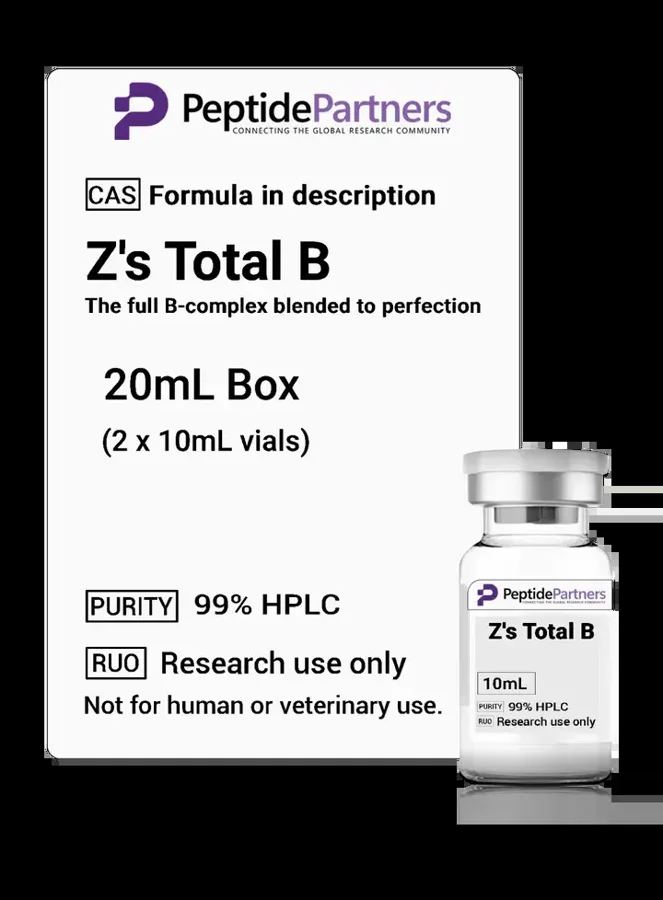
Peptides Partners lists B1 (Thiamine HCL) 10mL vials in 2 pack sizes, all in stock, with price per mg shown for each option. Browse more all products compounds in the Peptides Partners research peptide shop. All products are for laboratory research use only.