
PEPTIDES PARTNERS BLOG · November 11, 2026
Investigating Incretin and Gut Peptide Biology: The Research Science of GLP-2 and Tirzepatide
Metabolic biochemistry has increasingly focused on peptide hormones derived from the gastrointestinal tract. Over the past several decades, the study of enteroendocrine signaling has revealed complex networks regulating nutrient absorption, energy homeostasis, and systemic metabolic signaling. Among the biomolecules evaluated in preclinical and clinical literature, the proglucagon-derived peptides—such as glucagon-like peptide 1 (GLP-1) and glucagon-like peptide 2 (GLP-2)—alongside glucose-dependent insulinotropic polypeptide (GIP) represent major areas of exploration. More recently, engineered multi-agonist peptides like tirzepatide have expanded academic understanding of how concurrent receptor signaling alters metabolic cascades compared to selective single-receptor agonists.
The Evolutionary Arc of Incretin and Gut Peptide Discovery
The concept of incretin hormones originated in the early twentieth century when researchers hypothesized that gut-derived chemical messengers stimulated pancreatic endocrine secretions in response to oral nutrient ingestion. By the 1970s, GIP was isolated and characterized as the first definitive incretin peptide. Subsequent cloning of the proglucagon gene in the 1980s led to the identification of two distinct, tandemly arranged peptide sequences: GLP-1 and GLP-2.
While GLP-1 garnered immediate attention for its insulinotropic and glycemic regulatory functions, GLP-2 demonstrated a distinct physiological profile. Preclinical models demonstrated that GLP-2 was co-secreted with GLP-1 from intestinal L-cells but functioned primarily as an organ-specific growth factor that modulates intestinal epithelial growth, mucosal barrier integrity, and nutrient transport kinetics.
As single-incretin pathways became well-characterized, scientific interest shifted toward the interplay between multiple endocrine axes. The realization that endogenous GIP and GLP-1 signal via non-identical mechanisms spurred the design of synthetic unimolecular dual agonists. Tirzepatide emerged from this structural biology initiative as a synthetic 39-amino-acid peptide engineered to engage both the GIP receptor (GIPR) and the GLP-1 receptor (GLP-1R), providing an experimental framework to observe simultaneous, synergistic incretin modulation.
Molecular Mechanisms Investigated in Laboratory Models
In vitro and in vivo studies have sought to map the distinct and overlapping downstream cascades triggered by these biomolecules. Although both GLP-2 and tirzepatide stem from gut peptide biology, their molecular targets and investigated properties diverge significantly.
Tirzepatide: Dual GIP/GLP-1 Agonism
Tirzepatide is structurally based on the native GIP sequence, modified with non-coded amino acid substitutions and a C20 di-acid lipid moiety to confer extended stability and non-covalent albumin binding. Research demonstrates that tirzepatide functions as an imbalanced dual agonist: it exhibits affinity comparable to native GIP at the GIP receptor, but shows reduced potency at the GLP-1 receptor relative to native GLP-1. Researchers study how this biased or unbalanced engagement impacts cyclic adenosine monophosphate (cAMP) generation, receptor internalization kinetics, and beta-arrestin recruitment. In metabolic research models, dual GIP/GLP-1 stimulation has been studied for its effects on pancreatic beta-cell survival, differential glucagon secretion under varying glucose concentrations, and central nervous system signaling pathways related to appetite suppression and energy expenditure.
GLP-2: Epithelial Homeostasis and Gut Barrier Function
GLP-2 acts through the GLP-2 receptor (GLP-2R), a G-protein-coupled receptor predominantly localized in enteric neurons, subepithelial myofibroblasts, and enteroendocrine cells rather than enterocytes directly. Downstream signaling stimulates local mediators, such as insulin-like growth factor 1 (IGF-1) and keratinocyte growth factor (KGF), which promote crypt cell proliferation and inhibit enterocyte apoptosis. Investigators often study GLP-2 in preclinical models of intestinal mucosal damage, gut-barrier permeability, and the regulation of mesenteric blood flow to understand its influence on systemic metabolic inflammation.
Preclinical Focus Areas in Metabolic Research
Academic laboratories evaluate these pathways across several experimental paradigms:
- Dual vs. Selective Agonism: Controlled laboratory trials compare the metabolic outcomes of dual GIP/GLP-1 receptor engagement against selective GLP-1 receptor agonists, assessing markers of lipid utilization, adipocyte insulin sensitivity, and hepatic fat accumulation.
- Enteroendocrine Signaling Cross-Talk: Because GLP-1 and GLP-2 are co-secreted in equal stoichiometry from intestinal L-cells, researchers study how exogenous multi-agonists affect endogenous enteroendocrine feedback loops and intestinal peptide release.
- Intestinal Permeability and Endotoxemia: Preclinical models explore whether modulating gut mucosal integrity via GLP-2 receptor pathways alters systemic metabolic endotoxemia, particularly in models of high-fat dietary stress.
Comparative Summary of Investigated Peptides
| Peptide Entity | Primary Receptor Targets | Endogenous Origin / Class | Primary Preclinical Focus Areas |
|---|---|---|---|
| Tirzepatide | GIPR, GLP-1R | Synthetic dual incretin agonist | Glycemic regulation, cAMP signaling bias, adipocyte metabolism, beta-cell biology |
| GLP-2 | GLP-2R | Proglucagon-derived peptide (L-cells) | Crypt cell proliferation, mucosal barrier integrity, intestinal nutrient absorption |
| GLP-1 (Native) | GLP-1R | Proglucagon-derived peptide (L-cells) | Glucose-dependent insulin secretion, gastric emptying rates, central satiety circuits |
Sourcing Research Peptides: Comparing Vial Packs and Documentation
When procuring peptides such as tirzepatide or related metabolic sequences for laboratory investigation, consistency and analytical transparency are essential to maintain experimental reproducibility. Research-use-only (RUO) peptides sourced through Peptides Partners must be scrutinized against several objective quality metrics.
Evaluating Analytical Documentation
Peer-reviewed protocols require definitive proof of molecular identity and high purity before beginning assays. Reliable research suppliers accompany each batch with analytical documentation:
- High-Performance Liquid Chromatography (HPLC): HPLC chromatograms confirm peptide purity by showing the primary target peak relative to minor synthetic impurities or truncated sequences. Laboratories generally seek clear resolution without co-eluting chemical artifacts.
- Mass Spectrometry (MS): Liquid Chromatography-Mass Spectrometry (LC-MS) or Matrix-Assisted Laser Desorption/Ionization (MALDI-TOF) confirms the molecular weight of the peptide, verifying that the synthesized sequence matches the theoretical molecular mass of the target construct.
Comparing Vial Configurations and Aliquoting Strategies
Laboratories frequently decide between single-vial formats and multi-vial packs depending on experimental design. Lyophilized peptides remain stable longer in solid form under proper low-temperature storage. Therefore, obtaining multi-vial packs containing smaller individual masses (such as 5 mg or 10 mg aliquots) is often preferable to single large-mass vials. This setup allows researchers to reconstitute only the volume needed for immediate in vitro or in vivo experimental cohorts, minimizing the degradation risks associated with repeated freeze-thaw cycles.
Conclusion
The study of gut-derived peptides continues to redefine the understanding of multi-organ metabolic regulation. From the trophic actions of GLP-2 on the intestinal epithelium to the metabolic modulation observed with dual GIP/GLP-1 agonists like tirzepatide, these biomolecules provide critical tools for dissecting receptor pharmacology. When conducting in vitro or in vivo experiments, selecting validated, analytically characterized reagents from dedicated research providers such as Peptides Partners ensures the data integrity necessary to advance metabolic science.
Where to buy GLP-2 Tirzepatide for research
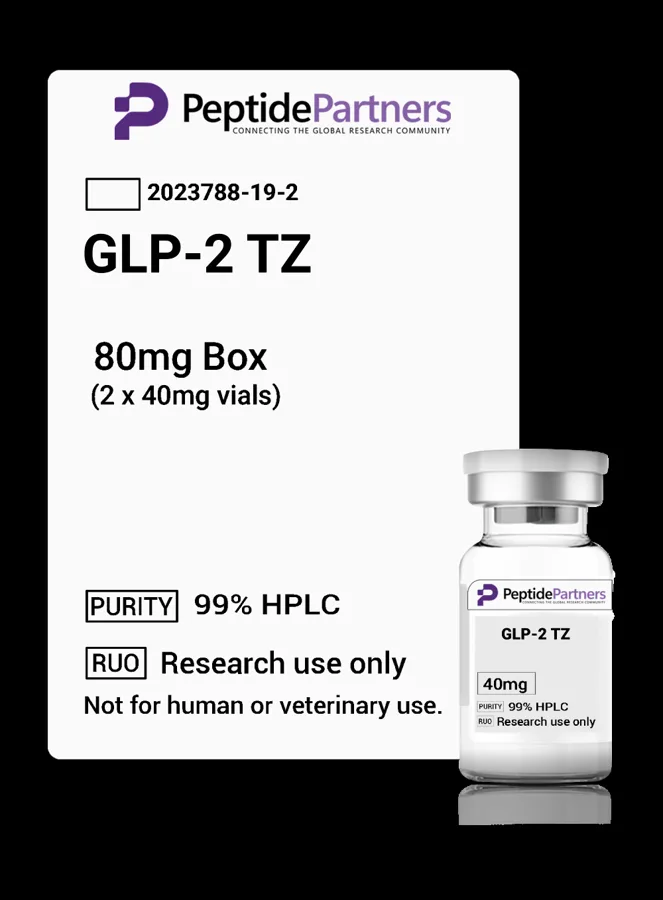
Peptides Partners lists GLP-2 Tirzepatide (40mg vials) in 5 pack sizes, all in stock, with price per mg shown for each option. Browse more metabolics compounds in the Peptides Partners research peptide shop. All products are for laboratory research use only.